2 Watercolor Fighter Jet Clipart Bundle
A Designer’s First Look: Loose, Lively, and Unexpectedly Versatile
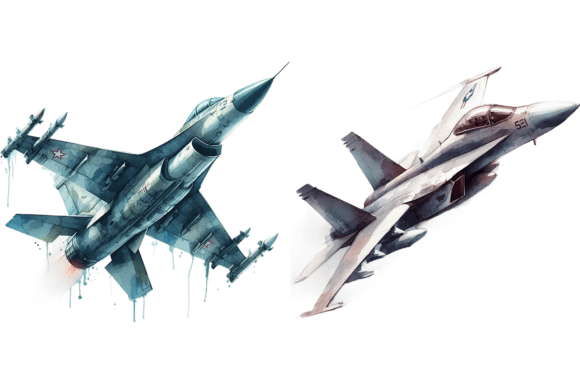
When I opened the 2 Watercolor Fighter Jet Clipart Bundle, I wasn’t expecting charm—but that’s exactly what hit me first. These aren’t hyper-realistic military schematics or sharp vector icons. They’re soft-edged, painterly jets—like someone sketched them mid-flight with a damp brush and let the pigment bleed just enough. One leans slightly forward, wings angled with quiet momentum; the other sits more upright, tail fin tilted like it’s winking. Both carry that effortless watercolor texture: subtle granulation, gentle gradients, and edges that breathe instead of cut. It’s illustration with attitude—and that makes all the difference for embroidery.
Why This Works (and Where It Shines) on Real Embroidered Goods
I tested the 2 Watercolor Fighter Jet Clipart Bundle as the centerpiece for a custom embroidered canvas tote bag—intended for an aviation-themed baby shower gift (yes, really). The design scaled beautifully to 4.5” wide, and its organic shape translated surprisingly well into satin stitch outlines and light fill-stitch bodies. Because the watercolor effect relies on soft transitions—not hard lines—it avoids the “over-stitched clutter” that plagues many detailed clipart files. On medium-weight cotton twill, the result felt handmade, intentional, and quietly sophisticated—not cartoonish or juvenile.
This bundle fits naturally into several real-world niches: custom apparel for aviation enthusiasts (think crew-neck sweatshirts or dad caps), personalized gifts for pilots or flight school grads, nursery decor where “military” reads more as “adventure” than “combat,” and even small shop merchandise like embroidered tea towels or aprons for aviation-themed cafés or boutiques. As Illustrations, they’re expressive enough to stand alone—but as Graphics, they’re clean enough to pair with simple typography or monograms without visual competition.
Where Caution Is Needed—Not Flaws, Just Realities
Let’s be direct: watercolor textures don’t always translate cleanly to thread. The 2 Watercolor Fighter Jet Clipart Bundle doesn’t include embroidery files—it’s PNG only. So if you’re planning machine embroidery, you’ll need to digitize it yourself or hire a digitizer. That means paying close attention to areas where the original art fades softly—like wingtips or exhaust trails. Those delicate transitions can easily become “lost” in dense fill stitches or vanish entirely on dark fabric unless contrast is carefully managed.
It’s not ideal for tiny hoop sizes (under 3”)—the subtle detail blurs at small scale. Avoid using it on stretchy fabric without robust stabilizer, and reconsider it for curved surfaces like baseball caps unless you’re comfortable adjusting stitch angles manually. Also, skip it for layered garments (e.g., hoodies with thick fleece backs) unless you test stitch density first—the soft edges can mute under heavy backing. And while it reads beautifully on light or mid-tone fabric, it needs thoughtful thread color selection on dark fabric; a single black outline won’t capture the watercolor nuance.
How It Shapes Perception—Beyond Just Looks
What surprised me most was how much the 2 Watercolor Fighter Jet Clipart Bundle elevated the perceived value of the finished product. Customers don’t just see “a jet”—they sense craft, care, and a point of view. That softness reads as handmade product, not mass-produced clipart. For Etsy sellers and craft fair vendors, that distinction builds trust. Buyers feel they’re getting something curated—not generic. It also supports brand consistency for shops with a relaxed, artistic aesthetic (think indie apparel brands or boutique nurseries). And because it’s distinctive but not overly literal, it invites engagement: people ask questions, smile, remember it. That kind of buyer engagement is gold for creative entrepreneurs.
Practical Notes Every Embroidery Designer Should Keep Handy
- Always test on scrap fabric first—especially with your intended stabilizer and thread combo. Watercolor tones behave differently on linen vs. cotton poplin.
- Check thread color contrast before stitching. Try grayscale mockups to spot areas where detail might disappear.
- Review stitch density in your digitized version—soft edges often need lower density or strategic running stitch accents to preserve breathability.
- Confirm hoop size early. These designs hold up best between 4”–6”, depending on fabric weight and desired impact.
- Inspect small details post-digitizing: cockpit windows, tail fins, and wing contours should remain legible—not fused into blobs.
- Test both light and dark fabric backgrounds. What reads as “gentle” on ivory may read as “faded” on navy.
- Use proper stabilizer: medium-weight cutaway for structured items (tote bags, patches); tear-away for lighter fabrics (baby onesies, pillow covers).
- Verify licensing before selling finished items or digital products. Since this is a digital embroidery file derivative, commercial use rights depend on the original license—check before listing on Etsy or bundling into craft kits.
Final Thought: A Quiet Standout in a Loud Market
The 2 Watercolor Fighter Jet Clipart Bundle won’t shout from a craft fair table—but it doesn’t need to. It draws people in with subtlety, rewards close looking, and carries enough personality to anchor a whole line of custom apparel, embroidered patch collections, or holiday embroidery projects. It’s proof that illustration doesn’t have to be loud to be memorable. For embroidery designers who value authenticity over algorithm-friendly flash—and for small business owners building something real, one stitched piece at a time—this bundle earns its place in the working library. Just remember: treat it like a sketch, not a blueprint. Let the watercolor guide your thread choices, your stabilizer decisions, and your confidence to keep it beautifully, intentionally imperfect.